Dry, brittle hair dulled by coloring, bleaching, or heat from styling tools? Tokio Inkarami treatment has established itself as one of the leading professional hair repair treatments. Unlike a conventional mask that merely coats the hair fiber's surface, this Japanese protocol works at the heart of the hair to restructure it.
The results are real, but gradual and vary from one head of hair to another, and they require proper maintenance to last. Here, without unrealistic promises, is how Tokio Inkarami treatment works, who it's really for, how much it costs, and how to extend its effects at home.
What is Tokio Inkarami treatment?
Tokio Inkarami is a Japanese hair treatment designed to deeply repair damaged hair, dry hair, or weakened hair. Whereas a superficial treatment temporarily plumps up the hair fiber, this protocol aims to restore its internal structure.
Its technology is based on a patented formula combining several keratins, amino acids, and fullerene, a molecule known for its antioxidant properties. This combination helps restore strength, suppleness, and shine to the hair fiber.
It's neither a shampoo nor a simple mask: it's a professional treatment system reserved for salons and hairdressers trained in the protocol. Expert application is essential to achieve the expected results.
How does Tokio Inkarami treatment work?
Understanding how Tokio Inkarami treatment works helps explain why it stands apart from conventional products.
Fullerene acts as a carrier: this molecule, whose discovery was recognized with the Nobel Prize in Chemistry, helps carry active ingredients to the heart of the hair fiber rather than just its surface. Keratins with different molecular weights then fill in and strengthen weakened areas, while amino acids help rebalance the hair's structure.
Important: Tokio Inkarami treatment is not a straightening treatment. It is certified formaldehyde-free and does not alter the hair's chemical structure. It is not intended to straighten curls, but to repair the hair fiber from within. It is a reconstructive treatment, not a relaxer.
The in-salon protocol, step by step
The treatment follows a precise sequence. Each step has a specific role, and together they create the repairing effect.
| Step | What the professional does | Role on the hair fiber |
|---|---|---|
| 1. Preparation | Purifying shampoo | Removes residue and impurities, preparing the hair fiber to receive the active ingredients |
| 2. Repair | Application of keratins and amino acids | Fills in and restructures damaged areas |
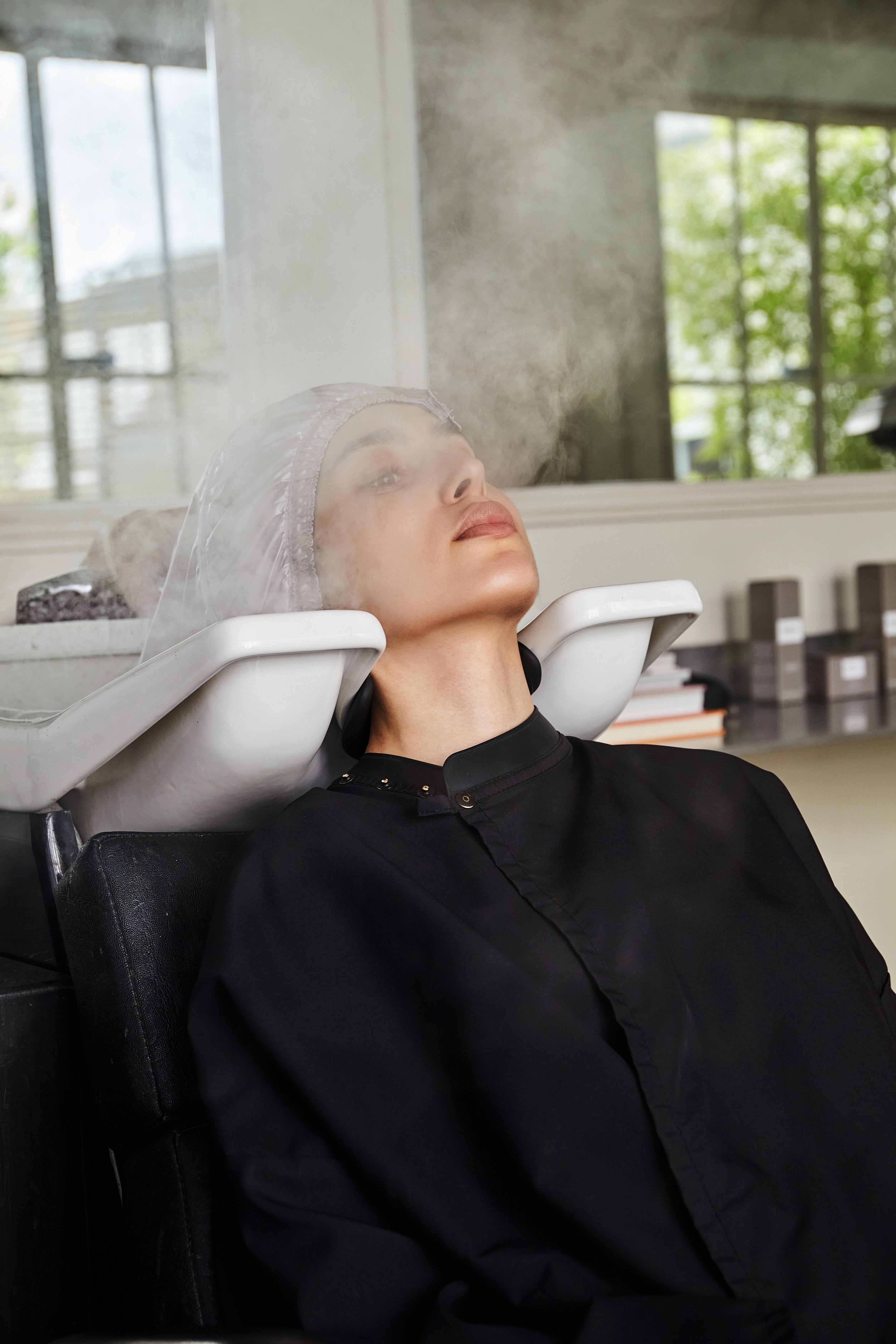
| 3. Intensive treatment | Concentrated active ingredients and fullerene, often with a gentle heat source | Carries nutrients into the core of the hair and protects it |
| 4. Rinsing and setting | Controlled rinsing | Sets the active ingredients and helps the hair fiber close |
| 5. Finishing | Drying and styling | Seals in the treatment and reveals softness and shine |
Processing time, temperature, and rinsing technique directly affect the results. That's why this treatment is performed in a salon by trained hands, rather than improvised at home.
Who is Tokio Inkarami treatment for?
The deciding factor isn't so much hair type as its actual condition. The treatment works best on weakened hair fibers.
It's particularly suitable for hair that has been repeatedly damaged by heat from styling tools, coloring, bleaching, or other chemical treatments. Porous, brittle hair or hair lacking elasticity benefits the most.
If you have curly or wavy hair, the treatment is perfectly suitable: it doesn't straighten it, but revitalizes it. Fine hair can also benefit, provided you use a lighter formula and measured amounts, as the brand offers several ranges at different intensities to suit different hair types.
However, for hair that's already healthy and not subjected to much stress, the benefits are limited. Too much protein can weigh down the hair fiber without providing any real benefit. Tokio Inkarami treatment is intended above all for hair that genuinely needs rebuilding.
How long do the results last?
After one session, the transformation is immediately visible: hair is smoother, softer, and shinier. This effect generally lasts between four and six weeks, depending on the hair's initial condition and maintenance routine.
Like all hair treatments, its effects aren't permanent: they fade over time and with washing, and require regular maintenance. The ideal frequency depends on the hair's type and condition.
| Hair type | Recommended frequency |
|---|---|
| Very damaged or sensitized | Once a week at first, then space out treatments |
| Normal to damaged | Every 2 to 3 weeks |
| Fine | Every 3 to 4 weeks, in small amounts |
Using it too frequently can instead overload the hair fiber, making it stiff or dull. Once again, a professional can help you adjust the frequency.
Tokio Inkarami treatment at home: is it possible?
The brand offers at-home care products designed to prolong the benefits of the treatment. However, the full protocol is performed in a salon under the supervision of a trained professional.
Why? Because the steps in the protocol are designed to work together. Separating the shampoo from the treatment, shortening processing times or rinsing too soon significantly reduces its effectiveness, sometimes leaving hair feeling heavy or sticky. At home, the focus is on maintenance: caring for your hair and making the results last, rather than rebuilding it. Remember to buy authentic products from authorized retailers.
Tokio Treatment price and where to get it
The price of a Tokio Treatment (the Tokio Inkarami protocol) depends mainly on hair length. At David Mallett, it's offered at the Notre-Dame des Victoires salon in Paris, in a session lasting around 60 minutes.
| Hair length | Tokio Treatment, 60 min (incl. tax) |
|---|---|
| Short hair | 120 € |
| Medium-length hair | 135 € |
| Long hair | 165 € |
| Very long hair | 185 € |
Prices are indicative and should be confirmed when booking. Good to know: at the salon, the Tokio Treatment is listed among hair treatments, separate from keratin treatments and Brazilian straightening. Further proof that it's a reconstruction treatment, not a relaxer.
A preliminary assessment of your hair's condition, porosity and elasticity helps tailor the treatment protocol. You can book online from the salon page, and technical services can also be arranged by phone.
How to care for your hair after the treatment
A reconstruction treatment doesn't replace a good daily routine - quite the opposite. In the weeks that follow, it's best to avoid harsh shampoos and aggressive brushing, and to apply a heat protectant before using any heated styling tool.
That's exactly where the David Mallett philosophy comes into its own. The house develops premium professional hair care, made in France, without parabens, mineral oil, phthalates or colorants, vegan and cruelty-free. These formulas, made with high-quality ingredients, respect the delicate nature of hair for results that always look natural. A gentle, premium routine chosen for your hair type helps protect the hair fiber and maintain its shine.
To put yours together, explore the brand's hair-type routines or essential treatments.
Frequently asked questions about the Tokio Inkarami treatment
Is the treatment suitable for color-treated hair? Yes. It is particularly recommended for color-treated or bleached hair, which is more fragile and porous, as it helps strengthen the hair fiber and reduce breakage. It can be done after coloring and does not affect the shade.
Is the Tokio Inkarami treatment suitable for curly hair? Yes, because it does not change the hair's structure or straighten curls. It revitalizes the hair fiber while preserving its natural movement.
Is there any risk to my hair? The treatment is designed to strengthen the hair fiber. Reported issues are most often due to incorrect application, an unsuitable range, or counterfeit products rather than the treatment itself. If you have a very sensitive scalp or known allergies, consult a professional before your appointment.
How many sessions does it take to see results? You can already see results after one session. For very damaged hair, some professionals recommend spacing out several sessions for more complete repair.
Is the treatment vegan and cruelty-free? It depends on the specific range: check with your salon. At David Mallett, all treatments are vegan, contain no animal-derived ingredients, and are not tested on animals.
The Tokio Inkarami treatment: an investment in healthier hair that lasts
Beyond the immediate effect, the benefit of the Tokio Inkarami treatment lies in its ability to genuinely improve hair fiber quality, not just its appearance. When targeted to the hair that needs it and maintained properly, it provides truly restorative care.
This is also the vision championed by David Mallett: natural, elegant beauty, supported by exceptional treatments that deliver lasting results and are easy to maintain. If your hair has been put through its paces by heat and chemical treatments, a Tokio treatment at the salon can make a real difference.